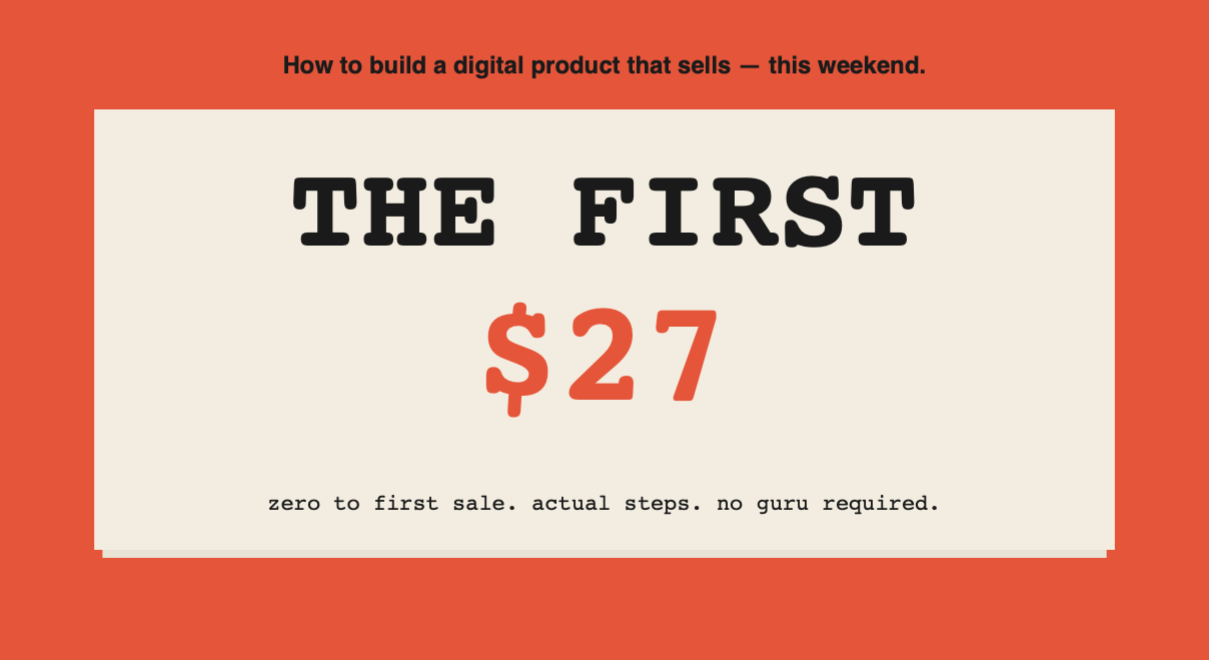
I want to tell you about the first product I ever made.
Not the polished version of the story.
The actual version, with the part where I almost didn’t publish it, the part where I underpriced it by accident, and the part where a stranger’s $17 purchase on a Tuesday afternoon changed the way I thought about my own knowledge.
Here’s the thing about the first product: it almost wasn’t a product at all.
Where it came fromI had spent about three years navigating a specific problem.
I won’t tell you exactly what it was partly because the specific topic doesn’t matter.
Too many people see a topic and think thats the only way.
The process is the same regardless of what the problem is. Focus on the process.
The point is: I had figured something out.
Over a long time, through a lot of wrong turns.
And I had accumulated a working understanding of something that a specific type of person…someone in the same situation…still struggled with.
I didn’t think of it as knowledge worth packaging.
I thought of it as just my life. My experience. My life lessons.
For months, I posted about adjacent topics, wrote about related ideas, built a small blog with a handful of readers.
And occasionally someone in the comments would ask: “How did you handle the X part of this? I’ve tried everything.”
The first time it happened, I wrote a long comment.
The second time, I wrote a slightly shorter one and linked back to the first comment.
The third time, I thought: I keep writing this out by hand. Maybe I should write it down properly.
That was the product idea.Not a market research exercise. Not a keyword gap analysis.
Three people asking me the same question.
How I built itOne Saturday morning. A blank document. A timer set for ninety minutes.
I wrote everything I knew about the problem. Not an outline. Not sections.
Just the answer to the question those three people had asked, written the way I’d write it if I had an hour and they were sitting across from me.
No preamble.
No “there are many ways to think about this.”
The actual answer.
I wrote for ninety minutes.
When the timer went off I had about 2,400 words and a headache.
I spent Sunday afternoon cleaning it up.
Cut the parts that were repetitive. Added a few headers so it was navigable.
Wrote a short introduction that named the problem specifically in the language the person asking it would use.
I made a cover in Canva. It took forty minutes.
It looked like something a real person had made with limited design skills and strong opinions.
Which is exactly what it was.
I put it in a PDF.
I created a Gumroad account and uploaded the file.
I priced it at $17.
The pricing mistakeI priced it at $17 because I was afraid.
Not consciously. I told myself I was being accessible. Meeting people where they were. Lowering the barrier to entry.
What I was actually doing was protecting myself from the specific fear of someone paying $27, reading the thing, and deciding it wasn’t worth $27.
At $17, if nobody bought it, the failure felt smaller.
At $17, if someone bought it and was disappointed, at least they’d only lost $17.
Neither of those is a business reason to price something. Both are fear reasons.
I found this out when, after six sales at $17, someone emailed me to say it had been the most useful thing they’d read on the topic.
They’d paid $17 for it.
I changed the price to $27 the next day.
The sales rate didn’t drop.
I had left money on the table for six sales out of pure, unexamined fear.
I price things with more confidence now. Not because I’m braver. Because I have data.
What it made — the honest numbersMonth one: $0. The product went live in week three. By month’s end, no sales. I told four people it existed.
Month two: $34. Two sales at $17. Both from people I knew in online communities where the topic was relevant. Neither of them had been actively looking for something , I’d mentioned it in a reply and they bought it.
Month three: $54. Three sales. One at $17 (before the price change), two at $27. The $27 sales came from the blog. People I’d never interacted with.
Month four: $81. Three sales at $27. All organic. I didn’t promote it once that month.
Month five: $216. Eight sales. I spent the entire month writing blog posts about the problem, not the product. The product just sat there and got found.
Month seven: $340.
Month nine: $1,100.
Month twelve: $2,400.
I want to stop here and name something important.
Month twelve was not a different product from month two.
Same PDF. Same Gumroad link. Same $27 price.
What changed between month two and month twelve was the amount of content pointing toward it, the size of the email list warming people to the topic, and the domain authority accumulating under the blog posts.
The product stayed the same.
The distribution grew.
That’s the whole story of the first year.
What I learned that I couldn’t have been toldI knew, intellectually, that you had to put something live before the market could respond.
I did not understand, emotionally, what that meant until I’d done it.
The specific feeling of publishing a product … of making something and putting a price on it and pressing publish is a feeling that does not exist in any amount of preparation.
It’s not fear exactly.
It’s more like standing at the edge of something with no way to know how deep the water is.
And then you jump.
And the first sale happens.
And the water is fine. Manageable. Real.
Not $10,000 in month one. Not validation that you’ve figured it all out.
Just: someone decided this was worth something to them.
That’s all it takes to change the question you’re asking.
Before: “Will anyone pay for this?”
After: “Who else should know this exists?”
The second question has answers.
The first one doesn’t… not until you build the thing and put it out there.
I still have the original PDF.
It’s not very good by the standards of what I’d build now. The formatting is uneven. One of the sections has a heading that doesn’t quite match what’s in the section. The cover is clearly Canva.
It made $2,400 in year one anyway.
Not because it was polished.
Because it was specific. And honest. And made by someone who had actually been in the problem and come out the other side.
That’s still the product.
It was always the product.
Want the guide I WISH I had before I started?
How to determine your first product
How to make it with AI
Yeah… Grab it here