You’ve Been Asking “What Should I Sell?” for Months.
The most common reason people never build a digital product isn’t laziness. It’s a specific, solvable problem.
Here’s how the first few weeks usually go.
You decide you want to sell digital products. Maybe you saw someone on Reddit making $340 a month from a PDF guide they wrote in a weekend. Maybe you’re tired of trading hours for dollars. Maybe you want something that makes money while you sleep or at the very least while you’re at work ignoring your email.
So you start researching.
YouTube videos about passive income. Reddit threads that promise real answers and deliver seventeen different opinions. Facebook groups with 50,000 members where every post gets the same three replies. Blog posts titled “27 Digital Product Ideas to Sell in 2026” that are just 27 variations of “make a template.”
You bookmark things. You take notes. You start a spreadsheet.
Then you research more.
Six weeks in, you know exactly how digital products work in theory. You can explain Gumroad’s fee structure. You know the difference between a PDF guide and a course. You’ve read four articles about finding your niche, each one contradicting the last.
You still don’t have a product.
This is not a you problem. This is a specific, recognizable place to get stuck. And the internet has a very profitable solution to offer you at exactly this moment of maximum frustration.
Buy a course about finding a product idea.
The course is the product.
You funded someone else’s business while trying to start your own.
Cool. Very efficient.
I’m not saying this to make you feel bad. I bought the courses. The $47 one. The $297 one. The $997 one that swore it was different from the $297 one.
It wasn’t different.
What I eventually figured out after spending more money on “research” than I’d like to put in print is that the question isn’t hard. The answer is almost certainly already in your head. You just need a structured way to pull it out before your inner skeptic talks you out of it.
The Part Nobody Explains Honestly
Most people approach “what should I sell?” the wrong way.
They start by looking outward. What’s trending? What sells well on Etsy? What did that person on Twitter make $11,000 from in a single launch?
This is backwards. It’s also why most of those products go nowhere.
WHAT YOU KNOW × WHO NEEDS TO KNOW IT = YOUR PRODUCT
Not what’s trending. Not what someone else is selling. Yours.
The workbook maps it in 15 minutes.
The Belief That Kills More Products Than Bad Ideas
Even when someone finds an idea they like, they kill it themselves. The thought sounds like this:
“I’m not qualified enough to teach this.”
This belief kills more good products than bad ideas ever have.
It’s also almost never true.
The workbook has a specific filter for it. A set of questions that tells you whether you’re actually unqualified — or whether you’re just running the same self-talk loop that stops most people before they start.
Most people who run it get the second answer.
Validation. Done in 20 Minutes, Not 3 Months.
Say you have an idea. Specific person, specific problem. Now what?
Do you just build it and hope someone buys it?
No. But you also don’t spend three months “validating” as a way to avoid building. Real validation is one question: is money already moving toward this problem?
There are four places to check. No paid tools. No market research firm. Twenty minutes and a browser.
The workbook walks you through exactly what to look for in each one — including the signals most people read completely wrong.
There are two failure modes in validation that nobody names. One makes you think you have a winner when you don’t. The other makes you abandon a solid idea because you looked in the wrong place. The workbook covers both.
Then You Pick One. And That’s the Hardest Part.
Here’s the thing that’s uncomfortable to say out loud but worth saying:
Most people don’t fail because they picked the wrong idea.
They fail because they never picked.
The only unrecoverable mistake is not starting.”
Version 1 will be imperfect. That’s not a problem — that’s the plan. Ship the imperfect thing. Real buyers will tell you what to fix in version 2. The feedback from one actual sale is worth more than six months of planning, every single time.
The workbook ends with a scoring matrix that tells you which idea to build first. Then a Final Product Statement template. Then a day-by-day build plan — actual days, actual tasks, so you finish the workbook on a Sunday and know exactly what you’re doing Monday.
Seven days. One free tool. Your knowledge, packaged.
What’s Actually in the Workbook
15 min
Find the overlap between what you actually know and what someone else is genuinely stuck on. Includes a specificity test most people need to run more than once.
10 min
A qualification test for your ideas. Not a credential check — a real-experience check. Ideas that pass stay in. Ideas that don’t come with instructions for what to do instead.
20 min
Four free tools. Twenty minutes. One answer: is money already moving toward this problem? Includes a signal-reading table and the two failure modes nobody warns you about.
15 min
Score your surviving ideas, write the Final Product Statement, and follow the day-by-day build plan. You leave with one idea on paper and a deadline to ship it.
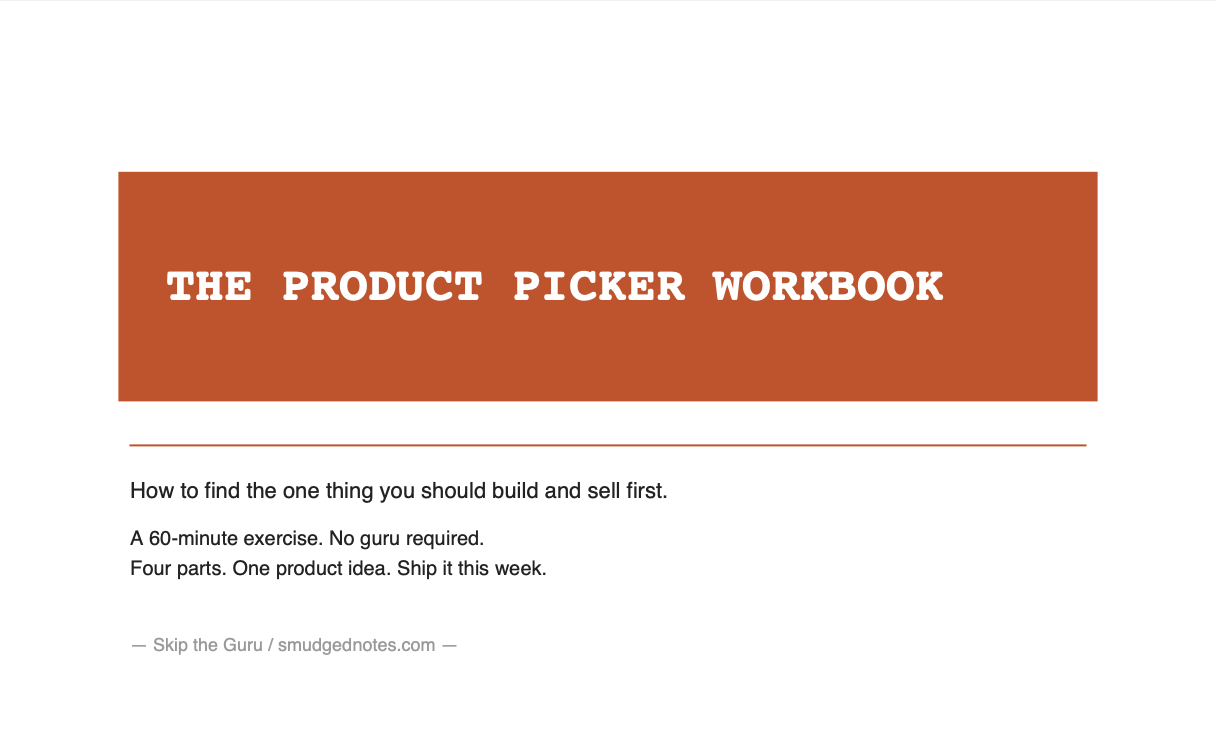
60 minutes total. By the end, you’ll have a specific product idea on paper rooted in what you actually know, aimed at someone who actually needs it, and priced at a number that’s actually reasonable.
“I’d been stuck on ‘what should I sell’ for almost four months. Saw Skip on threads and bought the workbook. By Part 3 I already knew which idea had legs. Listed my first product on Gumroad eleven days later. First sale came from a complete stranger. $34. Which sounds small. It really wasn’t.”
— Jamie T.
“I almost skipped this because I figured it was just another ‘brainstorm your passions’ exercise. It’s not. The filter in Part 2 alone was worth it. I’d been talking myself out of the one idea I actually knew well for six months. Did the Product Picker Workbook, ran the filter, ran out of excuses. Product has been live for five weeks.”
— Mike R., former teacher
60 minutes. One product idea.
One More Thing Worth Saying
The gap between “person with knowledge” and “person making money from that knowledge” is almost entirely a packaging and distribution problem. Not a talent problem. Not a credential problem.
Most people are sitting on a product they haven’t built yet. They know something that someone else would pay to learn. They have experience that someone six months behind them would genuinely benefit from.
I know because I was that person. Sat on the same idea for months. Convinced myself it wasn’t good enough, that I wasn’t qualified, that someone smarter had probably already done it better.
Then I used this exact process, built the thing in a week, and made $266 in the first seven days. Not because it was perfect. Because it existed and someone needed it.
The workbook handles the hardest part. The building part is on you.
But you already know something worth selling. You just haven’t written it down yet.
Anyway.
— Skip the Guru / smudgednotes.com
Stop Guessing What to Sell.
Start Here.
The Product Picker Workbook is $17.
Part one of the workbook takes about 60 minutes to produce one specific, validated product idea and a day-by-day plan to build it.
Part two of the workbook takes you about a week to build the product.