Digital Products · Skip the Guru
You’ve Been Asking “What Should I Sell?” for Months.
Here’s what’s actually happening — and a 60-minute fix that doesn’t cost $97.
Here’s how the first few weeks usually go.
You decide you want to sell digital products. Maybe you saw someone on Reddit making $340 a month from a PDF guide they wrote in a weekend. Maybe you’re tired of trading hours for dollars. Maybe you want something that makes money while you sleep — or at the very least while you’re at work ignoring your email.
So you start researching.
YouTube videos about passive income. Reddit threads that promise real answers and deliver seventeen different opinions. Facebook groups with 50,000 members where every post gets the same three replies. Blog posts titled “27 Digital Product Ideas to Sell in 2025” that are just 27 variations of “make a template.”
You bookmark things. You take notes. You start a spreadsheet.
Then you research more.
Six weeks in, you know exactly how digital products work in theory. You can explain Gumroad’s fee structure. You know the difference between a PDF guide and a course. You’ve read four articles about finding your niche, each one contradicting the last.
You still don’t have a product.
This is not a you problem. This is a specific, recognizable place to get stuck. And the internet has a very profitable solution to offer you at exactly this moment of maximum frustration.
Buy a course about finding a product idea.
The course is the product.
You funded someone else’s business while trying to start your own.
Cool. Very efficient.
I’m not saying this to make you feel bad. I bought the courses. The $47 one. The $297 one. The $997 one that swore it was different from the $297 one.
It wasn’t different.
What I eventually figured out — after spending more money on “research” than I’d like to put in print — is that the question isn’t hard. The answer is almost certainly already in your head. You just need a structured way to pull it out before your inner skeptic talks you out of it.
— — —
The Part Nobody Explains Honestly
Most people approach “what should I sell?” the wrong way.
They start by looking outward. What’s trending? What sells well on Etsy? What did that person on Twitter make $11,000 from in a single launch?
This is backwards. It’s also why most of those products go nowhere.
The products that actually sell — consistently, from strangers, without a massive audience or a big launch — start at the intersection of two specific things: what you already know, and who actually needs to know it.
WHAT YOU KNOW × WHO NEEDS TO KNOW IT = YOUR PRODUCT
Not what’s trending. Not what your favorite creator sells. Not the thing that got 800 upvotes in a subreddit about passive income.
Your specific knowledge. Their specific problem. That’s the whole formula.
The workbook starts here — with a 15-minute exercise to map where your knowledge and someone else’s problem actually overlap.
The Belief That Kills More Products Than Bad Ideas
Even when someone finds an idea they like, they usually destroy it themselves. The thought sounds like this:
“I’m not qualified enough to teach this.”
This belief has killed more good products than bad ideas ever have.
Your buyer isn’t looking for the world’s foremost authority on the topic. They’re looking for someone who already solved the exact problem they’re currently stuck on. Someone who remembers what it felt like to not know. Someone who can say “I did it this way and it didn’t work — do it this way instead.”
That single insight is worth $27 to the right person.
A person who ran their first 5K six months ago knows more about running a first 5K than anyone who’s never started. A freelancer who figured out how to quote their first client without panicking knows something that the freelancer about to do that for the first time will pay for.
You don’t need a certification. You need recent, specific experience with the exact problem they’re stuck on. You need to be one step ahead — not twelve steps ahead. The gap is the product.
The workbook walks you through three specific questions that tell you whether you’re genuinely qualified to sell an idea — or whether you’re being too hard on yourself. (It’s almost always the second one.)
Validation. Done in 20 Minutes, Not 3 Months.
Say you have an idea. Specific person, specific problem. Now what?
Do you just build it and hope someone buys it?
No. But you also don’t spend three months “validating” as a way to avoid building. Real validation is one question: is money already moving toward this problem?
Four places to check. No paid tools. No market research firm. Twenty minutes and a browser.
Etsy — Is anyone selling anything close to this? A listing with 200+ sales in your category isn’t competition. That’s proof that people buy. A listing with 5,000+ sales means the demand is real and established.
Google — Type your problem as a search phrase, the way someone would actually type it. If Google autocompletes it, people are searching for it. If the top results are all $997 courses with nothing in between — your $27 PDF that solves 20% of the same problem for 3% of the price is a real product waiting to exist.
Reddit and Facebook groups — Find where your target person hangs out. Search the problem. Look for threads where people say “I’ve tried everything and can’t figure out…” Each one of those threads is a person who would buy your product if it existed.
Gumroad — What are real, individual creators selling on this topic, for real money? A product with 500+ sales at $17–47 proves one thing: people pay strangers for this. You can too.
Find signals across three of those four channels, and you have something worth building. The workbook has a complete signal-reading table — including the two failure modes nobody warns you about.
Then You Pick One. And That’s the Hardest Part.
Most people don’t fail because they picked the wrong idea.
They fail because they never picked.
The market can’t tell you if your product is good until you ship it.
The only unrecoverable mistake is not starting.
Version 1 will be imperfect. That’s not a problem — that’s the plan. Ship the imperfect thing. Real buyers will tell you what to fix in version 2. The feedback from one actual sale is worth more than six months of planning, every single time.
The workbook ends with a scoring matrix — four dimensions, five points each — that tells you which of your surviving ideas to build first. Then a Final Product Statement template. You fill in the blanks, and you have a product on paper: specific person, specific problem, specific format, specific price, specific deadline.
Then it gives you a 7-day build plan. Day 1–2: brain dump everything you know into a doc. Day 3: add structure. Days 4–5: write the clean version. Day 6: format it in Canva. Day 7: list it on Gumroad. That’s it. That’s the whole launch plan.
What’s Actually in the Workbook
15 min
10 min
20 min
15 min
60 minutes total. By the end, you’ll have a specific product idea on paper — rooted in what you actually know, aimed at someone who actually needs it, and priced at a number that’s actually reasonable.
It’s free. It costs nothing. It does not require a $47 course about finding ideas.
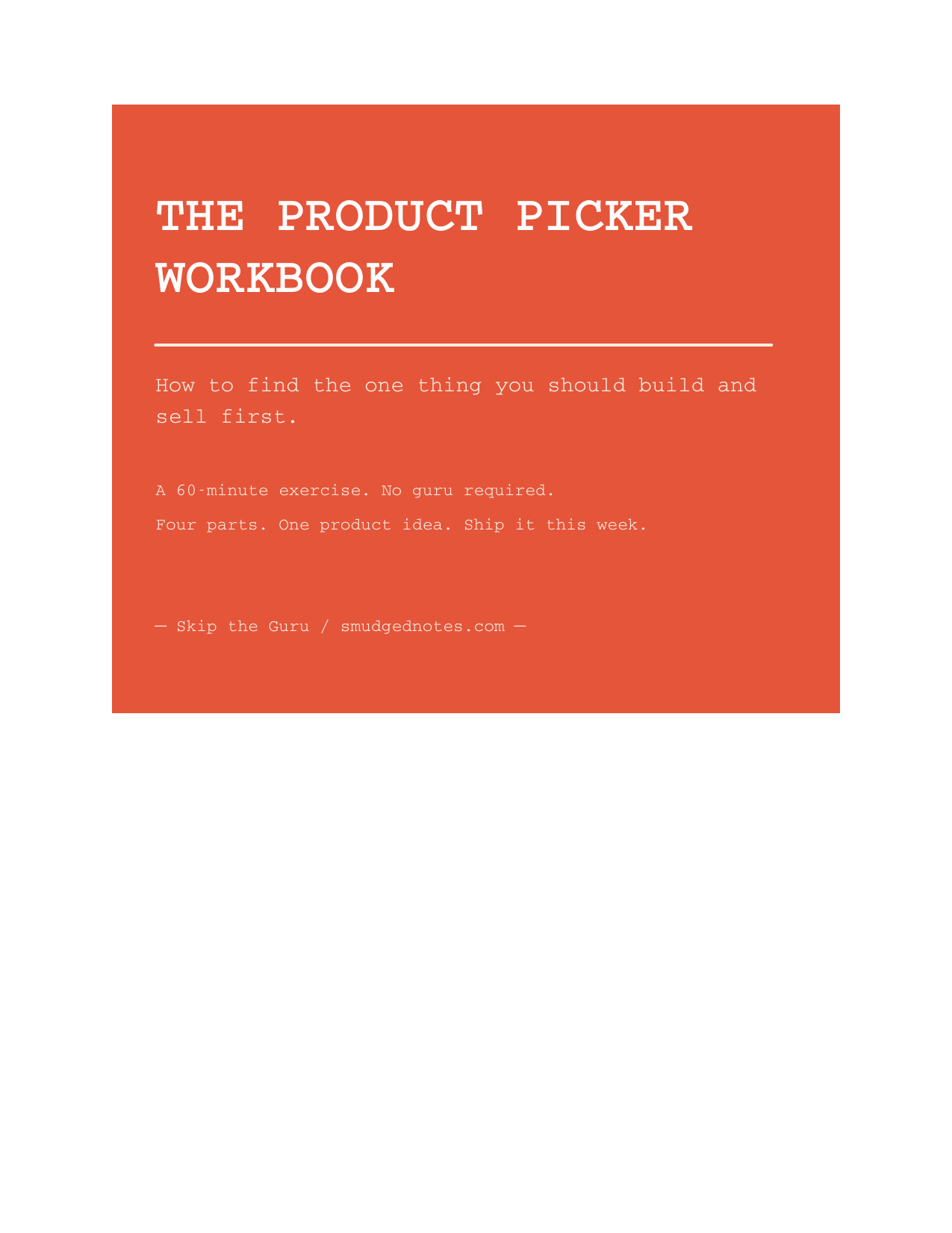
60 minutes. One product idea. No $97 course required.
Get the Free Workbook →— — —
One More Thing Worth Saying
The gap between “person with knowledge” and “person making money from that knowledge” is almost entirely a packaging and distribution problem. Not a talent problem. Not a credential problem.
Most people are sitting on a product they haven’t built yet. They know something that someone else would pay to learn. They have experience that someone six months behind them would genuinely benefit from.
The only thing between them and a first sale is figuring out what that specific thing is, confirming someone wants it, and then actually building it.
The workbook handles the first two. The building part is on you.
Do the thing or don’t. The opportunity doesn’t care either way.
Anyway.
— Skip the Guru / smudgednotes.com/
Stop Guessing What to Sell.
Start Here.
The Product Picker Workbook is free. 60 minutes. One specific, validated product idea — and a 7-day plan to build it.
Get the Free WorkbookFree. No catch. No upsell before you’ve even read it.